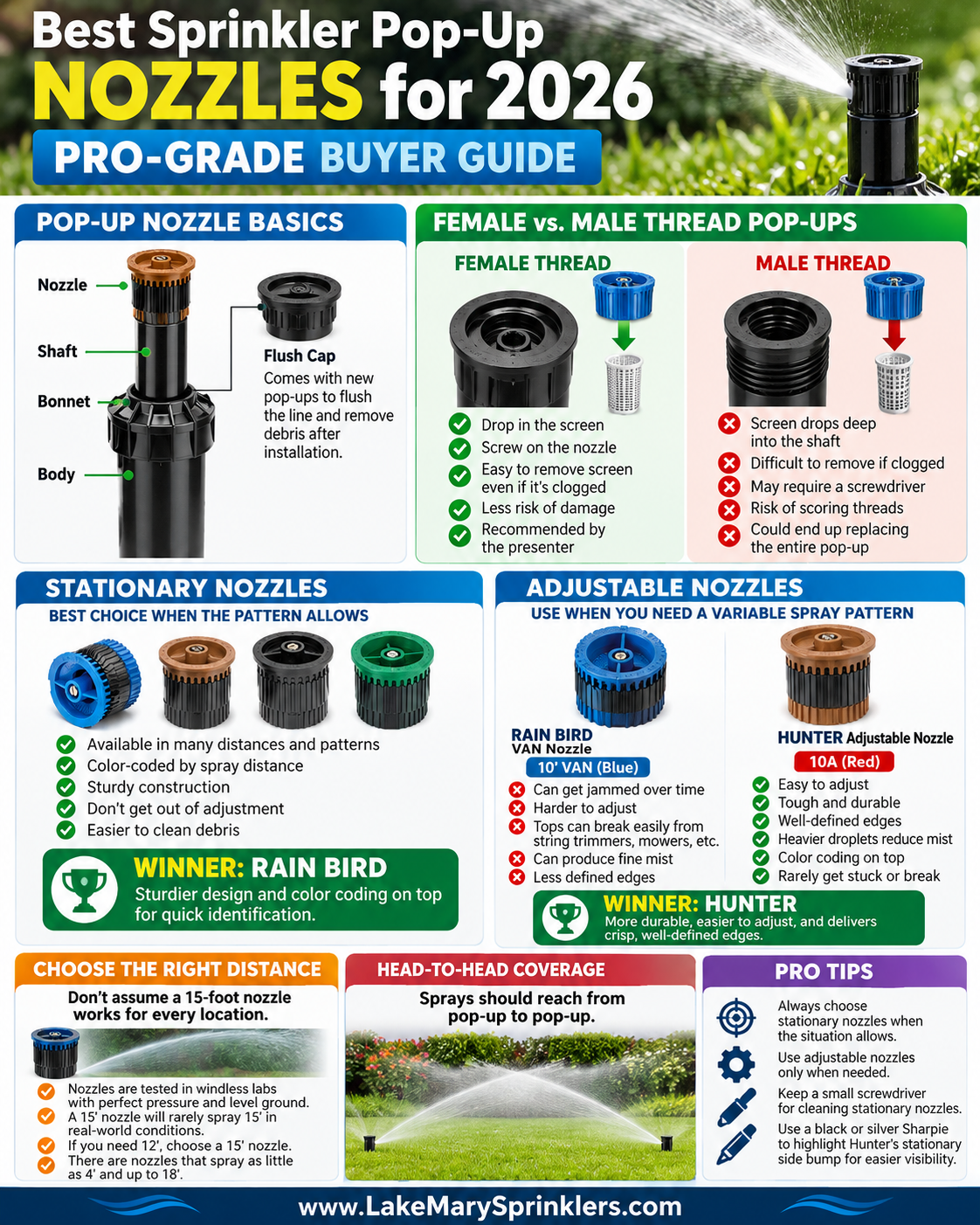
When it comes to irrigating your lawn, it’s often overlooked just how crucial it is to have the correct nozzle for the job. Pop-up sprinklers are made up of the main head, riser, and nozzle, and that nozzle is the final piece of the puzzle that determines how your water will be distributed, how far it will travel, and how quickly it will irrigate your lawn. Spray head nozzles also provide the option to adjust your spray area by moving them, and they’re ideal for small to medium size applications (about 4-15 feet). However, there are problems associated with older spray nozzles. Older spray nozzles typically distribute water very rapidly (think 1.5 to 2 inches of water every hour), resulting in a few issues:
Water cannot penetrate into the ground due to its rapid flow rate
Wind can disrupt the distribution of water.
Much of the water simply evaporates before it reaches the ground.
These issues result in wasted water and inefficient irrigation.
Spray Pattern Options: How to Get Water Where You Need It
There are many types of spray nozzles, each providing a variety of spray patterns depending upon the specific type of spray pattern needed to water your lawn or other landscaping elements.
Full Circle (360°):
This type of nozzle provides circular coverage, making it ideal for water the center of your lawn, or a circular bed of flowers.
Half Circle (180°):
Ideal for watering only one side of a bed or along a wall or edge of a walkway.
Quarter Circle (90°):
Perfect for corner applications such as a corner of a driveway or patio.
Three Quarter Circle (270°):
Useful when you need to leave a “hole” in the spray pattern; useful for watering around trees, mailboxes, etc.
Adjustable Patterns:
Offer flexibility in terms of the width of the spray pattern. Can be adjusted from 0 to 360°. Ideal for watering irregularly shaped lawns.
Strip Patterns:
Create rectangular patterns, perfect for narrow areas of your lawn such as between the sidewalk and street, or a narrow flowerbed.
Specialty Nozzles:
Some of the most popular specialty nozzles include bubbler nozzles designed for watering large trees and matched precipitation nozzles that deliver the same amount of water regardless of the spray pattern.
Major Brand Names & What Sets Them Apart
Rain Bird
One of the oldest and most recognizable names in the industry. Their U-Series spray nozzles are solid, dependable and available in a variety of colors for easy identification. While they are still a major player in the market, Rain Bird has introduced a number of innovative products including their R-VAN rotary nozzles. These nozzles feature rotating streams of water that help prevent evaporation and runoff, thereby conserving water and reducing water waste.
Hunter
Hunter revolutionized the industry with the introduction of their MP Rotators. These nozzles create multiple streams of water that rotate around slowly, rather than spraying water everywhere in a wide fan-shaped pattern. In addition to their improved performance, Hunter products are known for being durable and able to operate effectively even when water pressure is less-than-optimal.
Toro
Precision Series by Toro offers a variety of color-coded products that are easy-to-use and identify. Their rotating nozzles are easily identified and installed.
Orbit
Orbit is generally considered the most affordable option for homeowners who do not wish to invest a large sum of money in upgrading their irrigation system. Orbit nozzles are still high-quality and function efficiently, however.
Other Brands
In addition to Rain Bird, Hunter, Toro, and Orbit, K-Rain and Rain Bird’s Xeri-Bird line provide additional product options for consumers. The Xeri-Bird line was developed to conserve water.
Rotating Stream Nozzles: Why Everyone Loves Them
Rotating stream nozzles are among the best things to happen to sprinklers in recent history. Instead of producing a fine mist that disperses widely, rotating stream nozzles produce individual streams of water that slowly rotate as they exit the nozzle.
What makes them better:
Water penetrates the soil and does not run off. Older spray nozzles apply water at a rate of 1.5 to 2 inches per hour. Rotating stream nozzles apply water at a rate of .4 to .6 inches per hour. The soil has time to absorb the water. They are also useful for fixing zones that have sprays and rotors mixed together. As sprays and rotors have widely disparat precipitation rates, you can even out the distribution profile by chaning the sprays to stream rotors.
Less affected by wind. Larger water droplets are not blown around as readily as mist.
More evenly dispersed. The rotating streams fill-in gaps and disperse water more evenly.
Save 30-50% on water. Not a joke. Studies prove it. Reduce water waste = reduce water bills.
Reach farther. Many rotating stream nozzles are capable of reaching 15-20 feet or more, thus requiring fewer sprinkler heads overall.
Upgrading Your Irrigation System: It’s Easy!
While upgrading your irrigation system may require digging up your yard and replacing your entire pipe system, you don’t have to tear everything up to upgrade your nozzles. Simply remove your old nozzles, and replace them with the new rotating stream nozzles.
Step 1: Turn Off Your Sprinklers
Step 2: Remove Old Nozzle
Simply unscrew your old nozzles from the spray head sprinkler bodies.
Step 3: Install New Nozzle
Install your new rotating stream nozzles onto the existing sprinkler bodies. The new nozzles will screw directly onto the existing nozzles. Each installation should take approximately 30 seconds.
However, there are a few things you’ll need to think about:
Pressure Matters:
Rotating stream nozzles perform best within a pressure range of 25-45 PSI. Since most irrigation systems fall within this range, you shouldn’t have to worry about adjusting the pressure. If you have a system that operates at higher pressures, you may need to install a pressure regulator to bring the pressure back into the optimal operating range.
Replace Entire Zone:
Don’t mix old spray nozzles with new rotating nozzles in the same zone. The two types of nozzles distribute water at completely different rates, and mixing them could lead to some areas receiving too much water, while other areas receive too little.
Select Correct Radius:
Most rotating nozzles are color-coded. Determine the distance that your current sprinkler heads project water, and select a rotating nozzle that matches that projection distance.
Adjust As Necessary:
After installing the new nozzles, you will likely need to adjust the arc of the nozzle (the distance that the nozzle will spray) and possibly the radius (the distance that the nozzle will spray in a particular direction). Both adjustments can be made using small screws or slots located on the top of the nozzle.
Change Run Times:
Since the rotating nozzles distribute water at a significantly slower rate than the old spray nozzles, you will need to extend the length of time that you run the sprinkler heads. A good starting point would be to triple the length of time you previously ran your sprinkler heads. For example, if you previously ran your sprinklers for 10 minutes, try running them for 30 minutes.
Observe Performance:
Observe the performance of your newly-installed rotating stream nozzles during operation. Be certain that the spray pattern overlaps slightly, and allow the system to run through 2-3 complete rotations to observe the full pattern of the spray.
Maintaining Your Sprinkler System
Clean your nozzles regularly. Debris and dirt can clog your nozzles. Many nozzles have removable screens that can be rinsed clean.
Inspect your nozzles once a month. Inspect your sprinkler system during operation and look for heads that are pointed in the wrong direction, damaged nozzles, and unusual spray patterns.
Consider your yard: Do you have slopes? Slopes cause water to run off more quickly. Use rotating stream nozzles to combat slope-related water runoff. Windy? Same issue. Small areas under 6 feet? Use traditional low-angle sprays or bubble nozzles instead of rotating stream nozzles.
Final Thoughts
Irrigation technology has advanced significantly since the days of those old spray nozzles that blasted water in every direction. Today’s rotating stream nozzles conserve water, conserve money, and work better. The best part? Upgrading to rotating stream nozzles won’t require ripping up your entire yard.
Regardless of whether you’re installing a new irrigation system or repairing an old one, you’ve got more options than ever before. You can choose from a variety of spray patterns, choose from brands that meet your budget, and if you’ve got old spray nozzles, switch to rotating stream nozzles today.