
Traditional vs. 2-Wire Irrigation Systems: A Complete Guide
How Traditional Multi-Wire Irrigation Systems Work
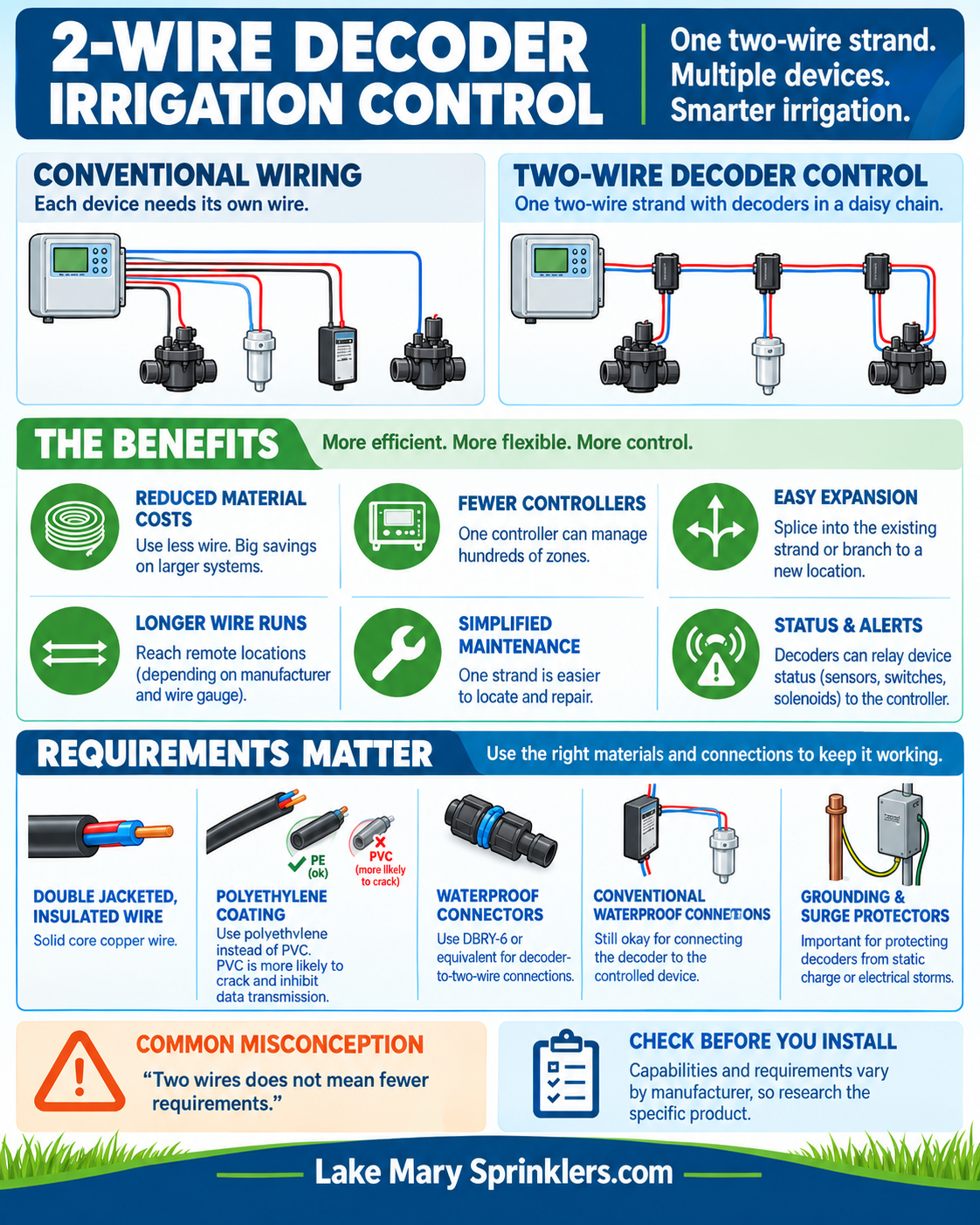
- Traditional multi-wire: one wire per valve plus common; controller sends voltage to open solenoids.
- Hidden costs: rising copper prices and expensive repair labor for buried wire damage.
- 2-wire system: single pair communicates with decoders addressing valves remotely, drastically reducing wiring needs.
- Decoders power solenoids and enable long runs; one controller can cover miles with correct wire gauge.
- Cost crossover around 25 to 35 zones; decoders increase hardware cost but save on wiring and expansion.
- Diagnostics: traditional troubleshooting is simple with a multimeter; decoders offer two-way diagnostics but require specialized tools.
- Best use: traditional for small residential under 20 zones; 2-wire for large, commercial, expandable systems and future proofing.
The Hidden Costs of Traditional Wiring
Rising Copper Prices
Traditional systems are relatively simple, and as such, have been a staple in the irrigation industry for many years. However, their simplicity does come with a price tag — literally. Copper prices continue to increase, and as such, the cost of copper wire continues to escalate. For example, according to the Sports Field Management magazine, traditional landscape sprinkler systems require a unique wire for each valve zone plus a common wire that connects them all, resulting in hundreds of linear feet of copper wire on a commercial property or a large community irrigation system with 200 or more zones. Therefore, the raw materials cost of copper wire alone can be a significant burden on a project budget.
Environmental Hazards and Repair Challenges
In addition to the cost of the wire itself, having more wire in the ground increases the risk of various hazards that can destroy irrigation wiring. These include rodent chew-throughs, shovel cuts during landscaping, and lightning strikes. Repairing damaged wiring bundles is a skilled and time-consuming process — repairing each individual wire in a bundle without mixing them is a difficult task. For example, a single cut in a 40-zone system can result in dozens of hours of labor.
Limitations When Expanding
Expanding a system is another challenge with traditional wiring systems. Adding new zones to a traditional system requires installing new wires back to the controller. Installing new wire on large properties can be extremely costly.
How 2-Wire Decoder Irrigation Systems Work
Communication Over a Single Wire Pair
Traditional irrigation systems are based on a simple concept of using a separate wire for each valve and connecting those wires with a common wire that runs back to the controller. In contrast, 2-wire decoder irrigation systems use a single pair of wires that run from the controller to the field, and each decoder is connected to these two wires. The controller continuously sends a low-voltage communication signal (usually 24 to 30 VAC or DC, depending on the system), and each decoder receives and responds to the communication signal. The controller identifies which decoder to send the communication signal to by sending the signal to a specific decoder address.
Hunter Industries explains that the architecture of 2-wire systems allow for a single controller to operate irrigation stations over long distances. With 14 AWG solid wire, solenoids can be activated as far as 10,000 feet (approximately 3 kilometers) away. Using 12 AWG wire will allow solenoids to be activated as far as 15,000 feet (approximately 4.5 kilometers) away. Additionally, a single controller can manage multiple 2-wire paths running in different directions across a property, thus allowing an enormous area to be covered with minimal wiring.
How Decoders Power Solenoids
Each decoder acts as a local power source for the solenoid of the associated valve. Decoders convert the communication signal sent by the controller into the voltage necessary to fire the solenoid. Most decoder systems are designed to function with the standard 24V AC solenoids commonly used in the landscape industry. Although some decoder systems use DC latching solenoids, the manufacturer must be contacted to confirm compatibility prior to combining the components.
2-Wire vs. Traditional Systems: Cost Comparison
Wire Savings at Scale
The most apparent advantage of 2-wire systems compared to traditional multi-wire systems is the cost savings associated with the lower amount of wire in the ground. As explained in Mottech’s decoder guide, instead of requiring a unique wire for each valve, a single pair of wires can potentially support hundreds of valves, resulting in substantial savings in terms of the cost of the wire and the cost of installing the wire.
When Does a 2-Wire System Become More Economical?
In a few instances, the cost savings of 2-wire systems may be offset by the cost of purchasing a decoder for each valve. Generally speaking, however, the crossover point where 2-wire systems become more economical than traditional systems is believed to be between 25 to 35 zones. As the size of the system grows beyond this point, the wire cost savings of a 2-wire system become increasingly more attractive. Sprinkler Warehouse notes that although the initial cost of hardware may be higher, savings on wiring and the ability to easily expand the system can offset the cost of the decoders, especially in large-scale applications.
Flexibility and Expansion
Adding New Zones
Another benefit of 2-wire systems is the flexibility of expanding a system. Since decoders are merely spliced into the existing wire path, adding new zones to a 2-wire system does not necessarily require running new wire back to the controller. An installer need only find the closest point on the existing wire path and tap in the new decoder. TWL Irrigation states that 2-wire systems provide no unused conductors and therefore, no spare wires are needed, keeping both the initial installation and subsequent modifications clean and inexpensive.
Flexible Station Numbering
Station numbering in 2-wire systems is also flexible. In traditional systems, the physical order of the valves in the field typically determines how the stations are ordered at the controller. In 2-wire systems, station numbers can be assigned by the installer — for example, station 3 can be placed anywhere in the field without affecting the operation of the station, as long as it is addressed by the controller. This provides greater flexibility to accommodate changes to the landscape plan either during or after the installation.
Diagnosing Problems in Each System
Troubleshooting Traditional Systems
Diagnosing problems in traditional systems and 2-wire systems differ based upon the type of problem being diagnosed.
In traditional systems, a non-operational zone is typically simple to diagnose — measure voltage at the controller terminals and at the solenoid, check the resistance, and follow the wire if needed. A digital multimeter ($20) is normally enough to diagnose problems. Finding a buried valve is also simple since standard cable tracing techniques can be used to trace the wire from the controller to the solenoid.
Diagnostics in 2-Wire Decoder Systems
Decoders in 2-wire systems possess built-in intelligence. In 2-wire systems, the wire path is a communication path. This enables the controller to use internal diagnostic features to determine the condition of the system, and the controller can signal alarms if issues occur with decoders, solenoids, or the wire path. The two-way communication capabilities of decoders enable decoders to send status data back to the controller, allowing modern controllers to generate automated warning messages if a problem occurs.
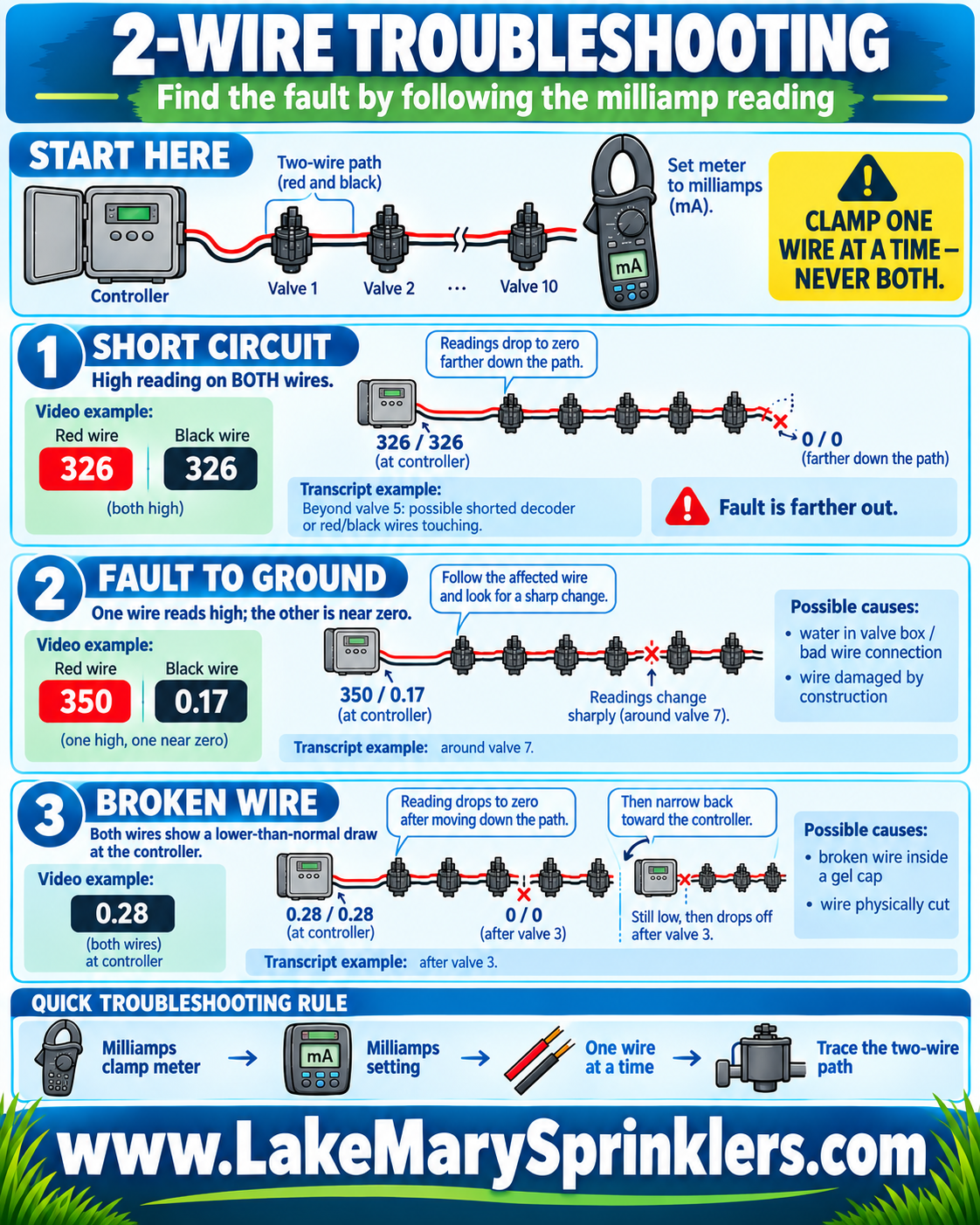
However, the method of using voltage and resistance measurements to diagnose decoder-based systems is limited. Due to the fact that the solenoids are downstream of the decoders, specialized equipment (a clamp meter capable of measuring milliamperage levels) is required to diagnose decoder functionality. Some manufacturers provide handheld programming and diagnostic tools that can communicate directly with decoders in the field, thus greatly reducing the time and effort spent on repairing irrigation large systems.
Resilience to Environmental Damage
Lightning Protection and Reduced Copper Exposure
One other notable difference between traditional systems and 2-wire systems is the manner in which environmental damage can affect the systems. 2-wire systems have fewer wires in the ground, thereby reducing the opportunity for environmental damage to the system. Specifically, 2-wire systems reduce the amount of buried copper exposed to corroding soils, mechanical damage from excavation, and lightning strikes. Hunter Industries reports that decoder-based systems are resistant to lightning strikes; although no irrigation system is completely resistant to lightning strikes, 2-wire systems have less wire in the ground and with proper installation including adequate grounding and surge protection, perform well in areas prone to lightning strikes such as Florida.
Installation Best Practices for 2-Wire Systems
It is worth noting that 2-wire systems require specific installation practices to ensure reliability. High-quality cable containing double-insulated twisted wire with a solid core is required. The outer jacket must be made of polyethylene, not PVC. All connection points must be completely waterproof, and decoders must be grounded to protect against electrical shock from static buildup. Cutting corners during installation often results in reliability issues later — as described in Husqvarna Water’s guide, the difference between a reliable decoder system and a faulty one is usually due to poor installation, not poor design.
To illustrate the magnitude of the wiring difference at scale, consider a large residential community with a shared irrigation system covering 200 zones. traditional multi-wire configuration would require at least 201 wires (200 hot wires plus one common) through the ground — a vast quantity of copper wire that is expensive to install and expensive to repair. In contrast, the same 200 zones can be operated with a single pair of wires with 200 decoders spliced along the length of the wire path. As a result, service calls will be quicker, additions will be simpler, and the decreased copper footprint will reduce both the cost of installation and long-term exposure to potential damage.
Which System Is Right for Your Project?
Small Residential Systems (Under 20 Zones)
So, who should choose a 2-wire decoder irrigation system? The short answer is — it depends on the scale and purpose of your project.
If you are planning a small residential irrigation system (i.e., a typical single-family home with 6 to 15 zones), a traditional multi-wire system will likely be sufficient. Wiring for small residential systems is easily managed, the cost of the equipment is reasonable, and diagnosing problems is accessible to any experienced irrigation technician. There is no need to purchase decoder technology for a system of this size.
Large Residential, Commercial, and Municipal Systems
In terms of 2-wire decoders, the logic is as follows: if you have a 20 zone residential system or larger; a commercial property; a golf course; or a community landscape (anything with 25 or more zones); or any scenario where future expansion is expected — then a 2-wire decoder system is economically and practically justified based upon wire savings alone on large install jobs, and the ability to expand zones into the future without having to rewire back to the controller is a true long-term benefit.
The Future of Irrigation Technology
Two wire decoder-based systems continue to gain traction within the industry due to decreasing costs associated with this technology. The ratio of new installations of decoder-based systems continues to grow, and some professionals predict that decoder-based systems may one day replace all traditional wired systems.
Many major manufacturers, such as Rain Bird and Hunter Industries, produce 2-wire decoder products. The Rain Bird ESP-LXIVM decoder supports 60-240 sectors, and the Hunter ACC2 decoder supports 75-225 sectors — both of which would be suitable for use in large commercial or municipal applications.
Final Thoughts
When properly designed and installed, both traditional and 2-wire decoder-based systems can provide a reliable and functioning irrigation system. The decision ultimately depends upon choosing the correct technology for the scale of the project, budget and long term vision of the property.
It is clear that decoder-based 2-wire technology represents significant improvements over previous technologies in terms of efficiency, scalability and diagnostic capabilities — features that become increasingly valuable as a system expands in size and complexity. Therefore, if you plan to design and build a large-scale irrigation installation or wish to “future proof” an existing system, it is definitely worth the time to learn about how decoder-based technology works and whether it is the correct technology for your needs.
If you are unsure of what type of system is best for your property, the most logical first step is to consult with a lawn sprinkler contractor who offers a variety of irrigation services. A skilled irrigation technician can assess your site, number of zones, soil conditions and budget to recommend the system that will meet your needs for years to come.