
Cycle and Soak Irrigation Programming for Central Florida Lawns
- Sprinklers apply water faster than soil absorbs it, causing runoff, wasted water, dry spots, and poor lawn performance.
- Cycle and soak splits one long run into two to four short cycles with soak periods, letting water reach the root zone.
- Central Florida soils: dry sand can become water-repellent; compacted fill, clay pockets, and slopes increase runoff and uneven moisture.
- Measure precipitation rate with cups, find each zone's runoff point, and set each cycle to about 80 percent of that time.
- Calculate total run time for 0.5 to 0.75 inch, divide into cycles under the runoff point, and allow 30 to 60 minute soaks.
- Program smart controllers or use multiple start times on older timers; begin early so all cycles finish before 10 a.m.
- Do not lengthen total watering, avoid mixed head types on one zone, fix coverage problems, and keep a working rain shutoff.
Cycle and soak, also known as syringe cycling, is one of the simplest, lowest-cost changes you can make to an irrigation system, and in our soils and under our watering rules it’s one of the most effective.
What Cycle and Soak Is
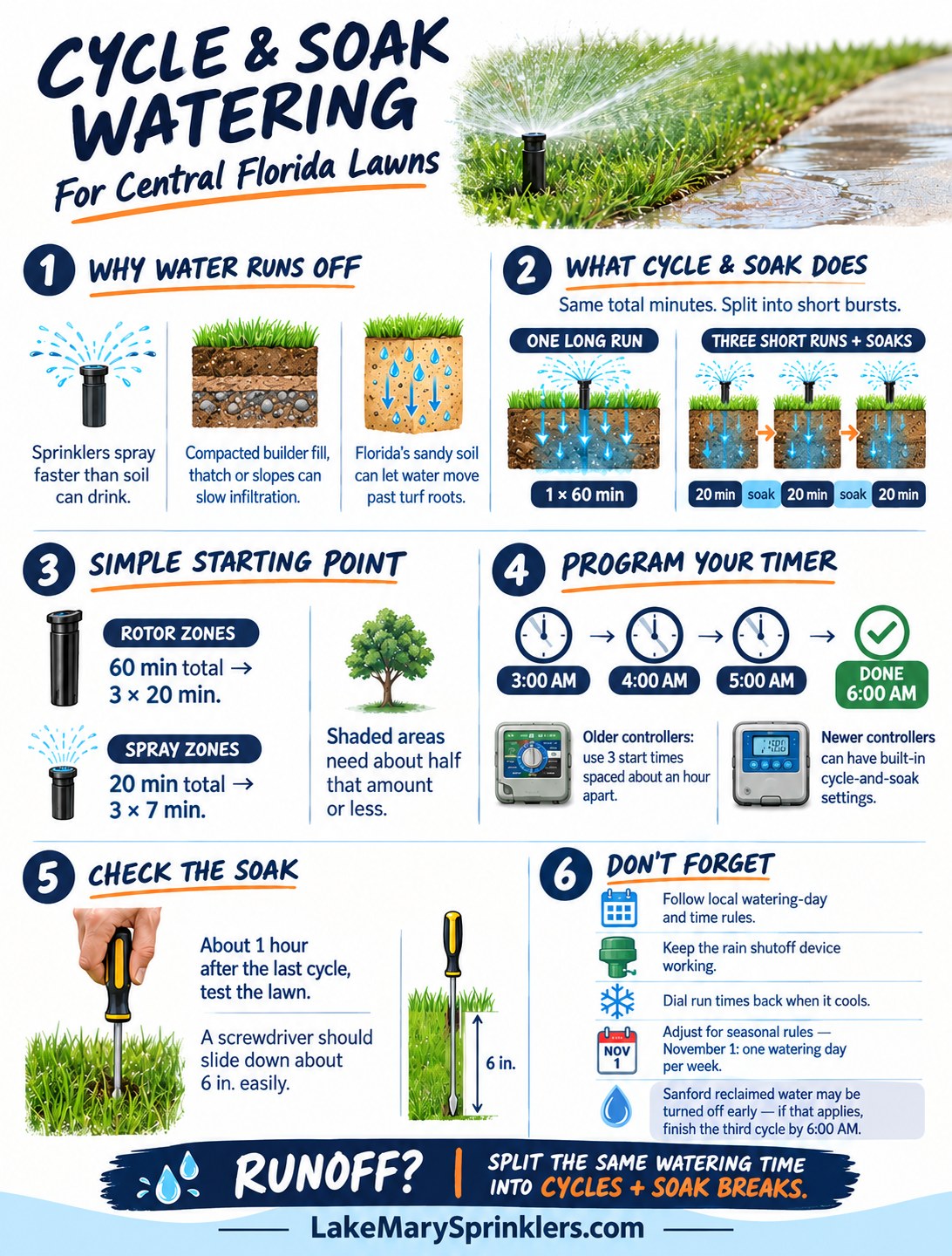
Instead of running each zone once for a long stretch, cycle and soak splits that run time into two to four shorter cycles with a rest period, the “soak,” in between. The total amount of water stays the same. What changes is the rate at which it reaches the soil.
Think of watering a dry kitchen sponge. Pour a cup on all at once and most of it rolls off. Pour a little, wait a few seconds, pour a little more, and the sponge absorbs nearly all of it. Soil behaves the same way. Each short cycle wets the surface, the soak period lets that water move down into the root zone, and the next cycle lands on soil that’s ready to absorb it.
Why It Matters in Central Florida
Sprinklers apply water faster than soil absorbs it. Even when soil can theoretically keep up, the surface often can’t, especially in the first few minutes.
Our sand isn’t as forgiving as it looks. Central Florida’s sandy soils drain quickly once wet, but dry sand can become water-repellent.
Organic coatings on sand grains cause water to bead up, run sideways, or channel down in narrow paths, leaving dry pockets right next to wet ones. Also, sometimes the water can deep percolate quickly before the roots can absorb it. That’s often the cause of stubborn brown patches in otherwise healthy St. Augustine. Short cycles with soak time re-wet the surface gradually, so later cycles soak in evenly.
Many yards aren’t native sand anymore. Newer subdivisions are often built on compacted fill, and many properties have clay pockets, slopes, berms, or retention pond banks. These areas shed water quickly and are where runoff shows up first.
Runoff carries more than water. Water that leaves your yard picks up fertilizer, grass clippings, and soil on its way to storm drains, which empty into our lakes, rivers, and springs. Keeping irrigation water where it lands protects local waterways and keeps the nutrients you paid for in your lawn.
Watering restrictions make every minute count. In the St. Johns River Water Management District, which includes Seminole County, irrigation is limited to no more than 3/4 inch of water and no more than one hour per zone per watering day, and watering is prohibited between 10 a.m. and 4 p.m.
When Eastern Standard Time begins on November 1, the schedule drops to one watering day per week. With that little opportunity to water, you can’t afford to lose a third of it to runoff. Cycle and soak lets you deliver your full allowance in a way the soil actually keeps. Always confirm the current schedule with your water management district and local utility, since cities and counties can add their own rules.
Better soaking means a healthier lawn. Even, thorough moisture through the root zone encourages deeper roots in St. Augustine, Zoysia, and Bahia, which helps grass ride out hot, dry stretches between watering days. It also reduces the soggy low spots where fungal problems tend to start.
How to Set It Up
1. Measure your precipitation rate. Place six to eight straight-sided cups or cans around a zone, run it for 15 minutes, and measure the average depth of water collected. Multiply by four to get inches per hour. Do this for each type of zone, since spray and rotor zones differ greatly.
2. Find your runoff point. Run a zone and watch closely. Note how many minutes pass before water begins puddling or flowing off the turf. Set each cycle to roughly 80 percent of that time. For many spray zones, that’s only 5 to 8 minutes.
3. Calculate total run time. Decide how much water you want to apply, usually 1/2 to 3/4 inch. Divide that by your precipitation rate and multiply by 60 to get total minutes.
4. Divide into cycles. Split the total run time into equal cycles that stay under your runoff point.
5. Set your soak time. Allow 30 to 60 minutes between cycles. Sandy, flat areas can use the shorter end; compacted soil, clay, and slopes need the longer end.
6. Program the controller. Most smart controllers have a built-in cycle and soak setting where you enter cycle and soak times per zone. On a conventional controller, use multiple start times with shorter run times. With several zones, the system naturally creates soak time: zone 1 rests while zones 2 through 6 run, then the cycle repeats.
7. Time it right. Start early, around 4 a.m., so every cycle finishes before 10 a.m. and the grass dries during the morning rather than staying wet overnight. Keep all cycles on the same scheduled day.
8. Check the results. The day after watering, push a long screwdriver into the soil. It should slide in easily 4 to 6 inches. Walk the property during a cycle and look for runoff or dry spots, then adjust.

Example Schedules
Zone type Precipitation rate Target Total time Cycle plan
Spray heads 1.6 in/hr 1/2 inch about 19 min 3 cycles of 6–7 min, 45-min soaks
Rotors 0.5 in/hr 1/2 inch 60 min 3 cycles of 20 min, 30-min soaks
Note that total run time across all cycles still counts toward the one-hour-per-zone limit.
Common Mistakes to Avoid
• Adding cycles without shortening them. Three cycles of the original run time triples your watering. Divide, don’t multiply.
• Mixing head types on one zone. Sprays and rotors on the same valve can’t be scheduled correctly, with or without cycle and soak.
• Running cycles into restricted hours or the next day. Make sure the last cycle ends before 10 a.m. on your assigned day.
• Expecting scheduling to fix hardware problems. Tilted, sunken, clogged, or mismatched heads cause dry spots that no schedule can correct. Coverage comes first.
• Ignoring the rain sensor. Florida law requires automatic systems to have a working rain shutoff device. Cycle and soak saves water only if the system also knows when not to run.
The Bottom Line
Cycle and soak costs nothing but a few minutes of programming, and it lets Central Florida lawns get full value from every watering day. If your lawn still shows runoff, dry patches, or uneven color after adjusting your schedule, the problem may be coverage, pressure, or soil conditions. A professional irrigation diagnostic can pinpoint exactly what’s going on, and Lake Mary Irrigation is here to help.