
Rain Sensors
How Irrigation Sensors Actually Work (And Why They Matter)
Smart irrigation sensors are taking over the lawn irrigation industry, including residential and agricultural applications such as golf courses.
Smart irrigation sensors fall into two main categories:
1) Rain sensors
2) Soil moisture sensors
Both types are relatively simple devices that greatly improve irrigation efficiency by detecting water conditions and adjusting irrigation accordingly.
Rain Sensors: What’s Going on Above?
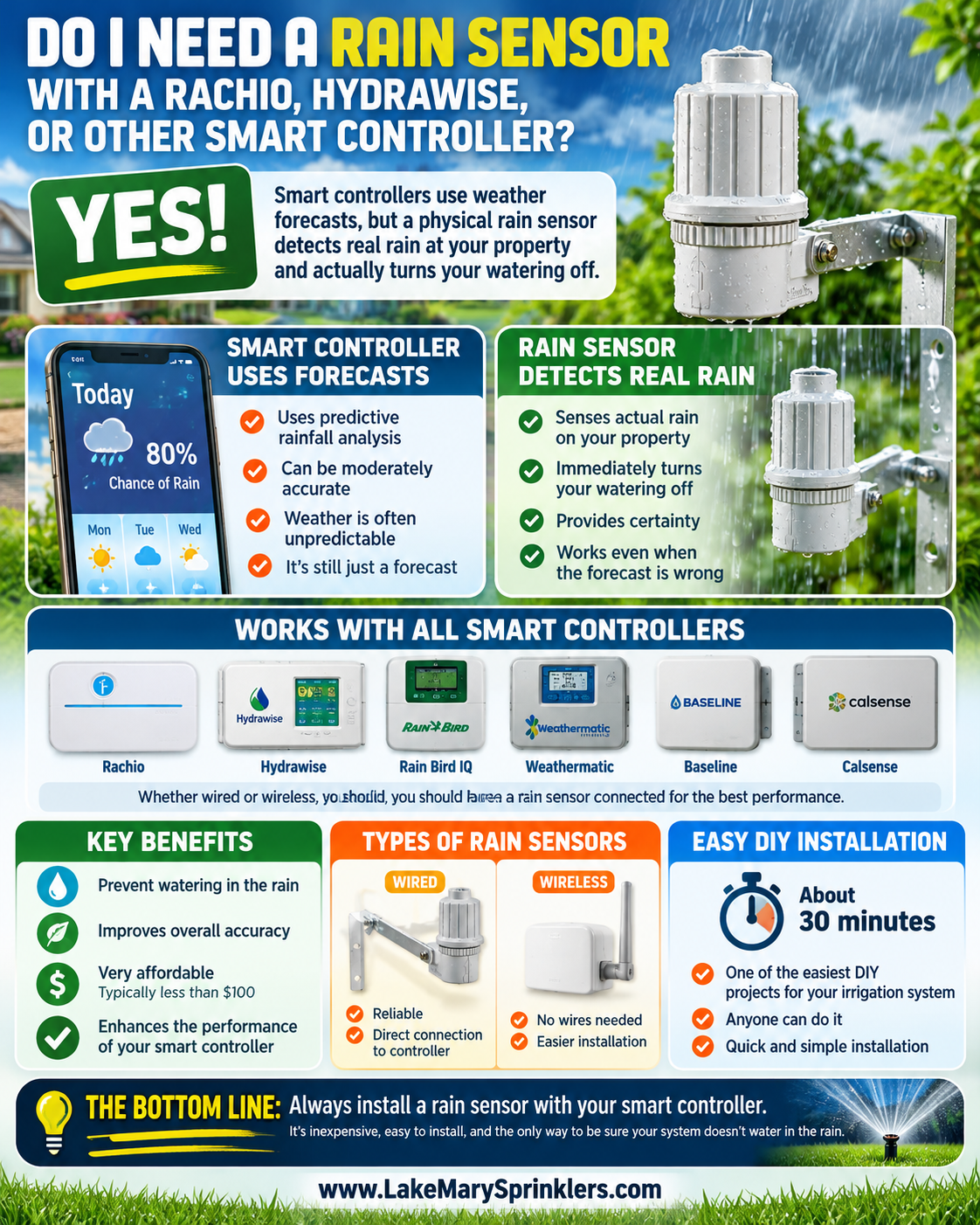
Think of a rain sensor as a guard for your irrigation system. The primary function of a rain sensor is to shut off your irrigation system when it rains.
Old-school Rain Sensors
In the 1970s, the first rain sensors were created. Essentially, a small plastic box contained disks that would absorb water. When it rained, the disks would swell, triggering a switch, shutting off your irrigation system. The disks would then have to dry out before they would turn back on. This usually took as long as your lawn remained wet.
Early rain sensors were somewhat effective, but they suffered from many limitations.
First, a rain sensor installed under a large shade tree would likely miss the majority of rainfall, due to wind blowing the rain around the sensor.
Second, your sprinkler heads may occasionally hit the sensor and cause false readings, leading to unnecessary shutdowns of your irrigation system.
Lastly, the disks within the old-style rain sensors would eventually clog with debris and mineral buildup. At some point, they would cease to function correctly.
Modern Rain Sensors

Today, rain sensors have improved significantly.
Some modern rain sensors use a bucket type design, which captures and measures precipitation in the same manner as a traditional rain gauge. Each time the bucket tips over, it counts a certain amount of rain and communicates this count to your irrigation controller. This allows your smart irrigation controller to determine the exact amount of precipitation received and make informed decisions regarding irrigation scheduling.
Other modern rain sensors use optical sensing technology. In this type of rain sensor, a light beam is transmitted through a small opening and hits a reflective surface. When rain strikes the reflective surface, it disrupts the light beam, sending a signal to your irrigation controller indicating that it has rained. Optical rain sensors generally operate very quickly, often providing immediate feedback to your irrigation controller.
The greatest improvement in modern rain sensors lies in their ability to communicate with your irrigation controller. While older style rain sensors simply activated/deactivated a switch, modern rain sensors provide detailed information regarding recent precipitation to assist your irrigation controller in making informed decisions regarding irrigation scheduling.
Soil Moisture Sensors: What’s Happening Below?
While rain sensors monitor precipitation events above ground, soil moisture sensors monitor moisture levels in the soil below ground. Soil moisture sensors provide critical information to help you manage your irrigation system, ensuring that your plants receive the correct amount of water to promote healthy growth.
Old School Soil Moisture Sensors
The first soil moisture sensors developed were called gypsum blocks. Gypsum blocks consisted of two metal rods inserted into a block of gypsum (the chalky white substance). As the surrounding soil became wetter/drier, the gypsum would either absorb/lose moisture. The gypsum’s electrical conductivity increased as it absorbed moisture. Therefore, by measuring the electrical conductivity of the gypsum, the moisture content of the soil could be determined.
Gypsum blocks represented a significant improvement in soil moisture measurement for farmers. However, they had their share of problems. The gypsum slowly broke down, requiring replacement approximately every few years. Additionally, gypsum blocks responded slowly to changes in soil moisture. Temperature fluctuations and high salinity soils negatively impacted gypsum block readings. Finally, gypsum blocks provided moisture readings for only a limited area in a given field.
Advancements in Soil Moisture Measurement
Subsequent advancements in soil moisture measurement led to capacitance-based sensors. Capacitance sensors measured the dielectric constant, which is a property that is affected much more dramatically by water than by air or soil.
The advantages of capacitance sensors lie in their non-invasive nature. Unlike gypsum blocks, capacitance sensors did not require direct contact with the water in order to measure its presence. Capacitance sensors responded rapidly to changes in soil moisture. Capacitance sensors could remain submerged in the soil for extended periods of time without degrading. Finally, capacitance sensors experienced minimal disruption from salinity in the soil.
Some capacitance sensors consist of long probes with multiple measuring points along the length of the probe. These allow users to gather data about moisture at various depths in the soil, giving users a clear understanding of where the water is being drawn by the roots and where it is being applied.
Highly Accurate Technology
Another highly accurate technology available today is Time-Domain Reflectometry (TDR). TDR involves sending an electromagnetic pulse down metal rods placed in the soil and measuring the time it takes for the pulse to reflect back. The speed of the pulse varies depending upon the moisture content of the soil. Therefore, the duration of time required for the pulse to reflect back provides a precise measurement of the moisture content of the soil.
TDR sensors are among the most accurate methods currently available for determining soil moisture. While TDR sensors are highly accurate, they historically were quite expensive. Historically, only large commercial operations and research institutions could afford TDR sensors.
However, prices have decreased in recent years, allowing smaller commercial growers to utilize this technology. In addition, there are other technologies available that offer high accuracy at lower costs than TDR sensors.
Wireless Connectivity
One of the most exciting developments in recent years has been the advent of wireless connectivity for sensors. Many sensors today can transmit data to the cloud via cellular network or satellite connection. Users can view this data on their smartphones or tablets from virtually anywhere.
Imagine a vineyard manager who has sensors scattered throughout his vineyards. Rather than drive from one end of the vineyard to the other, he can log onto his smartphone and access current moisture levels for each section of the vineyard. He can then identify areas that require additional irrigation and adjust his irrigation accordingly.
Similarly, a golf course superintendent can observe which greens are receiving excessive or inadequate moisture and adjust the irrigation accordingly, preventing damage to the turf.
Agricultural managers can visualize moisture levels across entire sections of their farm, and their irrigation equipment will automatically apply the correct amount of water based on those readings.
Additionally, wireless-connected sensors can learn. They can analyze historical trends, review weather forecasts, account for crop type and soil type, and adjust their recommendations accordingly. They do not require manual programming.
Instead, they continually adapt to changing environmental conditions.
Combining Both Types of Sensors
Using both rain sensors and soil moisture sensors together is far superior to using either type alone. Why? Because rain is not always equal to moisture in the soil where your plants need it.
To illustrate, consider a quick and intense thunderstorm. Your rain sensor detects the storm and turns off your irrigation system. Good, right? Maybe. If the heavy rain ran off quickly and most of it ended up in the gutter rather than penetrating into the soil, your plants may still be thirsty.
Conversely, a light drizzle lasting several hours may not activate your rain sensor, even though that steady soaking may have supplied your plants with all the moisture they needed.
Soil sensors address this issue. They tell you whether the rainwater penetrated into the soil sufficiently to satisfy your plants’ needs.
Many modern irrigation controllers combine both types of sensors. They detect rain, and then they assess whether the soil moisture has increased enough to warrant skipping the scheduled irrigation cycle. Conversely, if the soil moisture has not increased sufficiently after the rain event, the controller will proceed with the scheduled irrigation cycle.
Furthermore, modern controllers can differentiate between rain that falls locally versus a distant rain shower. For example, a rain sensor located near a large tree may register rain, but your soil sensor may indicate that the soil remains dry due to the tree’s canopy blocking the rain. The controller will then irrigate your plants as necessary.
The Future of Sensors
There are many new directions being explored in the development of sensors.
Drones equipped with specialized cameras are able to survey fields and detect plant stress prior to visible symptoms. Satellite imagery can similarly detect plant stress and deliver valuable insights to growers.
While these imaging technologies do not measure soil moisture directly, they provide important additional context for growers to evaluate how well their plants are responding to the moisture they receive.
Currently, scientists are developing sensors that measure multiple parameters simultaneously from a single probe, such as moisture, temperature, salt levels, and nutrient availability.
All these advances demonstrate that sensors have evolved beyond merely detecting rain or soil moisture, to become critical decision-making tools for any grower or land manager seeking to optimize water usage.
In many parts of the world, water is becoming increasingly scarce. With a growing population demanding more water, coupled with the ongoing effects of climate change, it is imperative that agriculture becomes more efficient in terms of water usage.
Sensors, particularly those designed for irrigation control, represent an essential tool for any grower looking to optimize their system.