
Calculating GPM Using a 5 Gallon Bucket
- Understand available water before designing a sprinkler system; meter supply and neighborhood changes affect flow.
- GPM measures flow (gallons per minute); FPS measures water speed (feet per second) affecting pressure loss.
- Pipe size chosen for required GPM and acceptable velocity; higher velocity increases pressure loss per foot.
- Economics drive using smaller pipe sizes; larger pipes reduce loss but cost significantly more.
- Typical 3/4" residential meters supply about 18–20 GPM; design zones for 15 GPM or less.
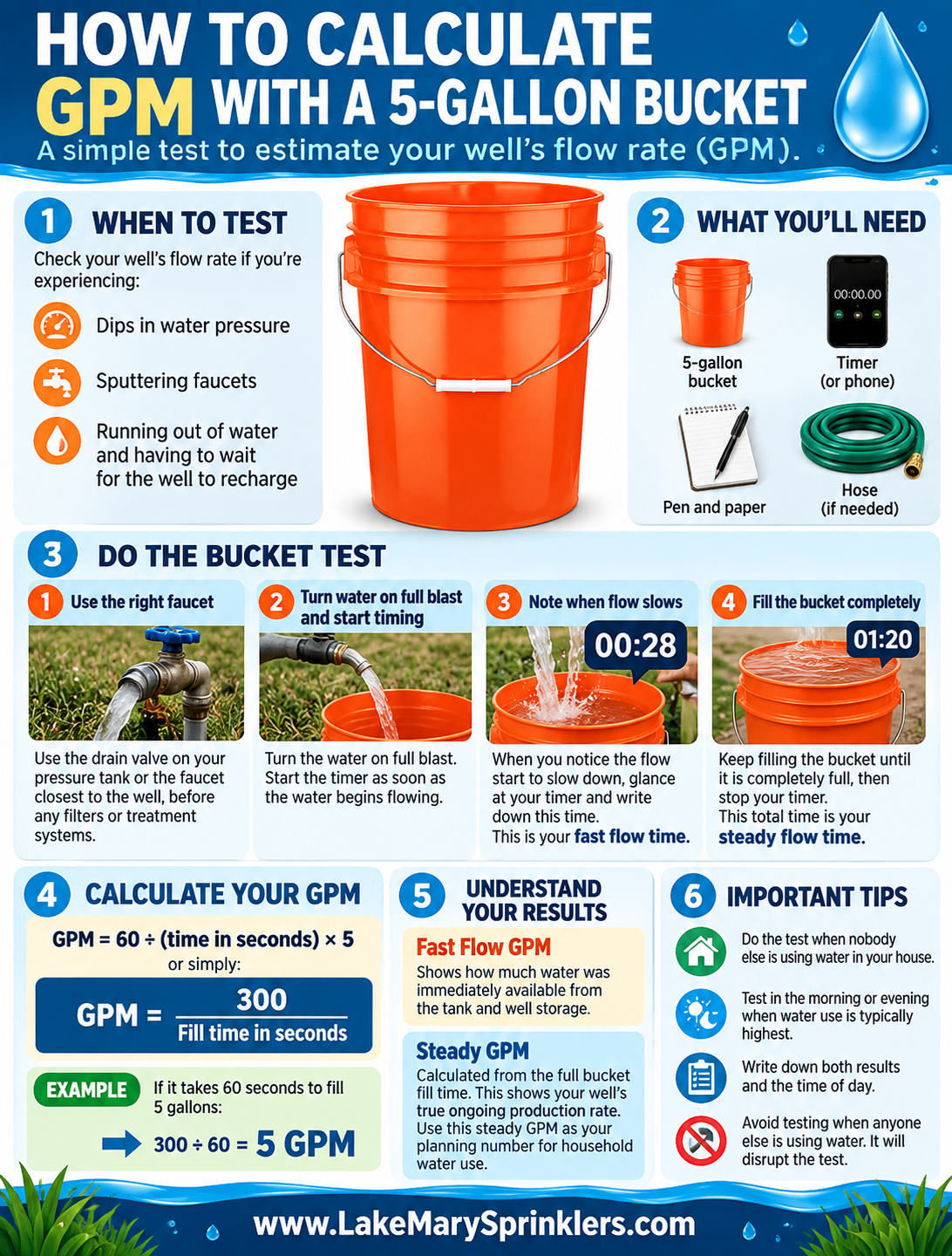
- Five-gallon bucket test: fill bucket, divide 5 by seconds, multiply by 60 to calculate maximum GPM.
- Design zones conservatively (smaller GPM per zone) to ensure reliable irrigation, even if costlier.
Calculating GPM with a 5-gallon bucket
Know your water supply before you design a sprinkler system
The bucket test
Place a 5-gallon bucket under the hose bib, open it fully
Time how many seconds it takes to fill to the top
5÷s
×60
Divide 5 by the seconds, then multiply by 60
The formula
×
60
=
max GPM available
What a typical meter supplies
3/4″ residential meter
At 40–60 PSI
18–20 GPM
Recommended max per zone
Leaves margin for reliable pressure
10–12 GPM
Build zones for 15 GPM or less — and consider sizing even smaller (10–12 GPM) so the system runs reliably as neighborhood demand changes.
Why pipe size and zone size matter
1 sprinkler, 2 GPM
½″ pipe, under 5 FPS
0.78 PSI loss / 100 ft
10 sprinklers, same ½″ pipe
20 GPM total, 9.56 FPS
21.47 PSI loss / 100 ft
Same pipe, ten times the flow — velocity nearly doubles the recommended 5 FPS max, and pressure loss jumps almost 30×. This is why zones get split rather than run off one large pipe.
Sprinkler systems can be traced back to 3000 BC when the ancient Babylonians built irrigation systems from clay and straw. In modern times we use PVC in warmer areas of the country and polyethylene tubing in areas where the ground freezes. Some large commercial properties will also use ductile iron for very large mainlines.
Many people want to install their own residential sprinkler system. The first thing you need to know is how much water do you have?
Before we calculate how much water we have to design a home sprinkler system, we first need to understand why that is necessary.
Affects on Flow Rate

Pipe Sizing
The size of the pipe used in an irrigation system is dependent on how many gallons of water is required and at what velocity. The higher the velocity the more pressure is lost due to water turbulence per foot of pipe.
The speed of water moving through a pipe is calculated at feet per second, or FPS. The amount of water moving through the pipe is calculated at gallons per minute, or GPM. When calculating for drip irrigation the formula is gallons per hour or GPH.
Economics of Pipe Sizing
The reason multiple pipe sizes are used in lawn sprinkler systems is due to economics. A sprinkler requiring 2 gallons per minute can use Class 315 half inch pipe. At two GPM the velocity to fulfill that requirement is less than 5 FPS. The resulting pressure loss over 100 feet would be 0.78 PSI which is acceptable.
You could also use one inch or even ten-inch pipe. Your GPM would be the same but the velocity of the water would be much slower, meaning less pressure loss per 100 feet. The problem is that the larger PVC pipe and fittings would cost much more than the half inch.
However, if you had ten 2 GPM sprinklers on the same half inch pipe the velocity would be 9.56 FPS (almost double the recommended maximum of 5 FPS) and the pressure loss per 100 feet would be an unacceptable 21.47 PSI.
You can easily see this by using the pressure loss chart below.
Larger PVC fittings cost more than smaller ones, so a contractor saves money by using smaller pipes and not running everything off one inch.
Available Water from the Meter

Many three-quarter inch residential meters can supply around 18 to 20 gallons per minute at 40 to 60 PSI. Most sprinkler systems off these meters are built (or should be) for 15 GPM or less zones. You want to size the system a little lower than your maximum availability to make sure your irrigation will run correctly.
I have seen low pressure systems where the homeowner will tell me “yeah, I had plenty of pressure until they built that 200 home subdivision down the street.”
The amount of water available to your house can change if they add more houses to your street but don’t increase the main water supply pipe to the area.
To know how many GPM you have available at your home we can either use a flow meter gauge to test it, available at the Big Box stores, or do a five gallon bucket test.
Calculating GPM with a 5 Gallon Bucket
If you have a smartphone, you already have a timer and calculator. Place the 5-gallon bucket under your hose bib and open it all the way. Turn it off just as the water gets to the top or 5-gallon mark.
Divide 5 gallons by the number of seconds needed to fill the bucket, then times that number by 60 to obtain your maximum GPM available.
Example: If it takes 19 seconds to fill the bucket, divide 5 by 19 which equals 0.26315789473. Now, times that number by 60 and you get 15.789.
This means you have at the very most 15 GPM to design your lawn sprinkler system. Personally, if I were in this situation, I would not make my zones over 12 GPM, maybe even 10 GPM.
Of course, that means more valves, more PVC material, and a larger controller. That makes the irrigation system a little more expensive. But it would be a sprinkler system that would work well, not a weak system that can barely water the grass.
If you must err on one side or the other, go with zones that are too small versus too big. You will be glad you did.
