
Stream Rotors Explained: How MP Rotators Compare to Spray Nozzles and Rotor Heads
- MP Rotators are multi-stream rotary nozzles that deliver several heavier streams by a rotating grooved plate for more even, wind-resistant coverage.
- They use matched precipitation so quarter, half, and full arcs apply water at the same rate for uniform zones.
- Low precipitation rate about 0.4 inches per hour means much longer run times, but less misting, runoff, and wind drift.
- Easy retrofit: screw MPs onto existing spray bodies, no digging, often saving up to 30 percent water versus fixed sprays.
- Best for slopes, hard-packed soil, windy yards, narrow strips, reclaimed water, and mid-size areas roughly eight to thirty-five feet.
- Fixed spray nozzles water fast at about 1.5 to 2.0 inches per hour, cheap and simple, ideal for small beds and tight corners.
- Rotor heads like Hunter PGP serve large turf 17 to 46 feet, require more pressure and rotor bodies, overlapping MPs near thirty-five feet.
I’ve been servicing irrigation systems around Central Florida for over 50 years, and stream rotors have gone from a specialty part to one of the upgrades I recommend most. They aren’t right for every zone, though. Here’s where they came from, what they’re good at, and how they stack up against regular spray nozzles and rotors like the Hunter PGP.
Where the MP Rotator came from
Funny enough, the MP Rotator started on farms. Nelson Irrigation, a family company out of Walla Walla, Washington, spent the 1980s reworking the old impact sprinkler. What they came up with was the Rotator, which uses a spinning grooved plate to split water into several streams. Farmers put them on center pivots all over the country.
Nelson eventually took that idea to lawns. Its subsidiary, Walla Walla Sprinkler Company, released the MP Rotator in the early 2000s as a nozzle that threads onto a standard spray body. The clever part was matched precipitation at any arc and radius. Turn a head down to a quarter circle, or pull its throw in a few feet, and the nozzle cuts its own flow to match. It still puts down water at the same rate as the full-circle heads in that zone. Anyone who has tried to balance a zone of mismatched spray nozzles knows why that was a big deal. The MP2000 won Best New Product at the International Irrigation Show the year it came out.
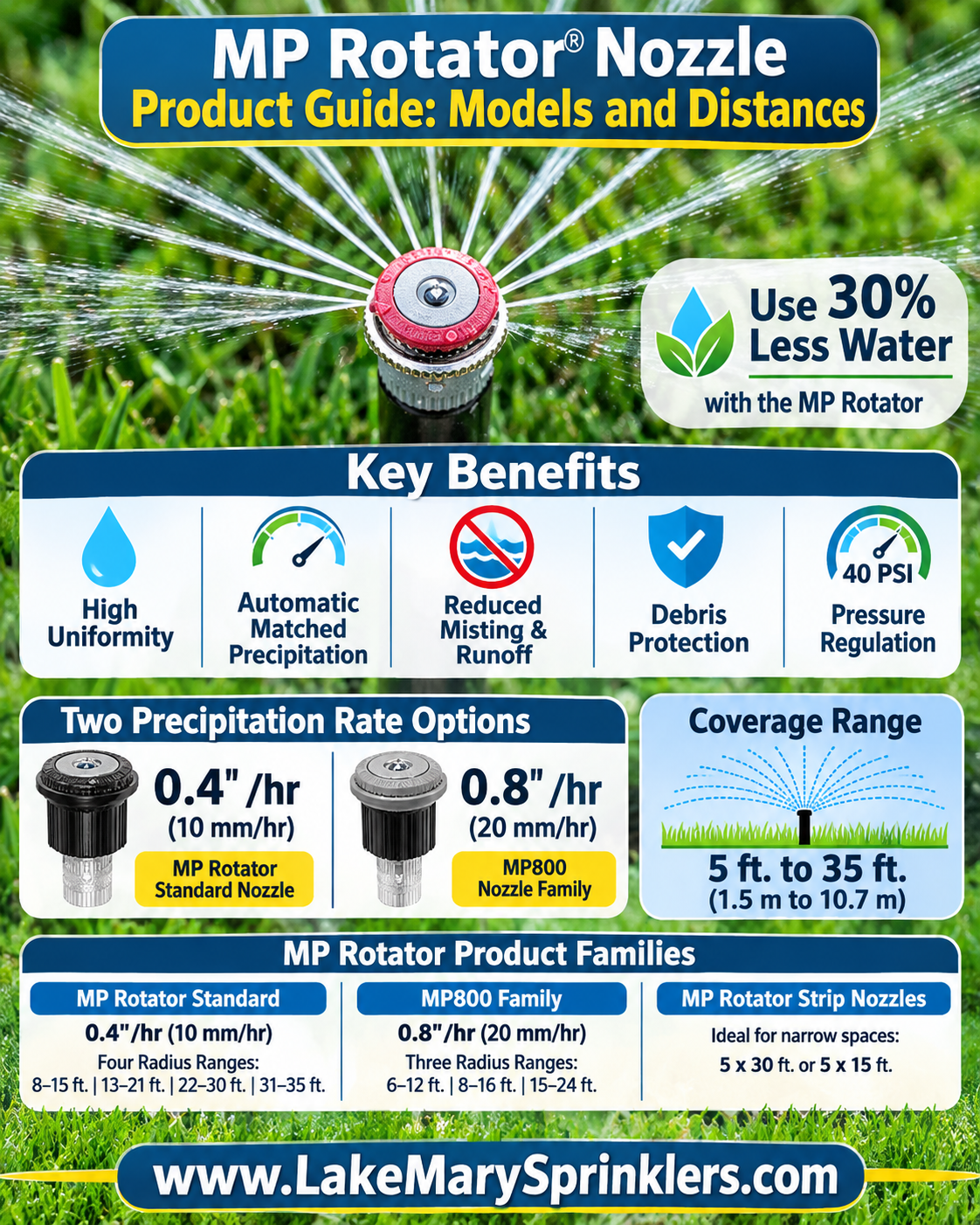
Hunter Industries bought the line in 2007 when Nelson decided to stick to agriculture. (Hunter’s own story starts in 1981 with the PGP rotor, which comes up again below.) Today the standard lineup covers 8 to 35 feet: the MP1000 (8–15 ft), MP2000 (13–21 ft), MP3000 (22–30 ft) and MP3500 (31–35 ft), along with corner and strip models. Standard MPs put down about 0.4 inches of water per hour. The MP800 series runs about twice that, at 0.8, for small areas.
How a stream rotor works
It sits on the same pop-up body a spray nozzle uses. When the zone comes on, the riser comes up first, and then the nozzle pops up a second time on its own. That second pop keeps sand and grit from getting packed into it. Water running through the nozzle turns a slow-moving head with channels cut into it, and each channel sends a stream out at a different angle. Some streams reach the far edge while others land closer in, so the whole pattern gets covered as it turns.
The streams are a lot heavier than spray mist, so wind doesn’t push them around as much. Spreading the water out over time also keeps the rate low enough that the ground can take it in.
Where they make sense
Retrofitting old spray zones is the big one. In a lot of cases you unscrew the old nozzles, screw on MPs and set the arc. No digging, no new pipe. Hunter says that can save up to 30% of the water compared to regular sprays, though your results depend on how far off the old system was.
They’re also a good fit for slopes and hard-packed soil, where the slow rate gives water time to soak in instead of running off. Open, windy yards are another, and so are the narrow strips along driveways and sidewalks, where the strip models keep water off the concrete. And they fill a gap. Plenty of yards have areas that are too big for a spray and too small to be worth a full-size rotor, roughly 15 to 35 feet, and that’s right where MPs work best. You’ll also see them used a lot on reclaimed water.
One thing that’s different here in Florida: our sandy soil soaks up water fast, so runoff isn’t usually the problem it is on clay. What you get from MPs here is more even coverage and less wind loss. The catch is run time. Because they water slowly, they need to run a lot longer, and that has to fit inside the days and hours the St. Johns River Water Management District allows.
MP Rotators vs. spray nozzles
A standard fixed spray throws about 5 to 15 feet and wets the whole pattern at once. That’s why it waters so fast, usually around 1.5 to 2 inches per hour.
Sprays aren’t junk. They’re cheap, there’s nothing inside them to wear out, and they get the job done with short run times. For small beds, tight corners and anything too narrow for an MP, they’re still the right call. Their problems are misting when pressure runs high, drift on windy days, runoff, and coverage that’s often uneven.
MPs go the other way. At about 0.4 inches per hour, a zone of them can need three or four times the run time of a spray zone to put down the same water. Each nozzle costs more, you can only pull the radius in about 25%, and they’re picky about pressure. Hunter recommends 40 PSI, which is what a regulated body like the Pro-Spray PRS40 gives you. Run them well off that pressure and they won’t perform the way the chart says they will.

MP Rotators vs. rotor heads like the Hunter PGP
The PGP is a gear-driven pop-up rotor, and it’s the product Hunter was started to make. The current version, the PGP Ultra, throws 17 to 46 feet and puts down roughly 0.4 inches per hour, depending on the nozzle. Rotors are for big turf. Because they reach so far, you need fewer heads, less pipe and less trenching to cover a large lawn. On the other hand, they need more pressure and flow, the gear drive is one more thing that can wear out, and part-circle heads have to be nozzled correctly or the zone won’t water evenly.
The MP3500 goes out to 35 feet, so there’s some overlap with the short end of the PGP’s range. When a job lands in that overlap, it usually comes down to what’s already in the ground. MPs go on the spray bodies you already have. A PGP needs its own rotor body.
On paper, MPs and PGPs water at about the same rate. In the real world, spacing and nozzle choice change that, so I still like to keep each type on its own zone. And don’t put either one on the same valve as fixed sprays. Set the timer for the sprays and the rotor areas come up short. Set it for the rotors and the spray areas get swamped.
How I Normally Use Them.
Because I no longer do new installs I use them for repairs. If I see sprays and rotors mixed on the same zone, I’ll replace the spray nozzles with the stream nozzles. This will improve the distribution uniformity for that zone.
Another use is for micro climates. Sometimes I’ll find a zone with sprays in the sun watering turf and sprays in the shade watering shrubs. This is the exact opposite of ideal as the shrubs in the shade need much less water. An easy fix is substituting MP Rotators for the shade heads. Now when the zone runs the shade shrubs get less water than the turf sprays.
And lastly I often find spray zones with weak pressure because there are too many heads (too many Gallons Per Minute) on the zone. By changing the spray nozzles to stream rotors I can cut the GPM on that zone in half. Presto! Now it has good pressure.
Side by side
| Fixed spray nozzle | MP Rotator (standard) | Hunter PGP Ultra | |
| Radius | 5–15 ft | 8–35 ft | 17–46 ft |
| Precipitation rate | ~1.5–2.0 in/hr | ~0.4 in/hr | ~0.4 in/hr (varies by nozzle) |
| Run time | Short | Long | Long |
| Moving parts | None | Rotating nozzle | Gear drive |
| Best for | Small beds, tight spaces | Retrofits, slopes, strips, mid-size areas | Large turf areas |
So which one should you use?
Honestly, most yards end up with some of each. Sprays still belong in small beds and tight spots. Rotors like the PGP are still what I’d put on a big open lawn. MP Rotators cover everything in between, and they’re about the easiest way to get more out of an older spray system. The right mix for your yard depends on the layout, your water pressure and your watering schedule, and that’s easiest to sort out with someone looking at the system in person.
Q: Which MP Rotator model should I use for a given distance?
A: The MP800SR handles the tightest spaces, the MP1000 short throws, the MP2000 medium runs, and the MP3000 or MP3500 the longest. Check each model’s listed radius range and pick the one your measured distance falls inside.
Q: Can I mix different MP Rotator models on the same zone?
A: Yes. Every MP Rotator shares a matched precipitation rate, so a quarter circle, half circle and full circle all apply water at the same rate. That lets you mix models and arcs on one zone and still water evenly.
Q: What arc range do MP Rotators cover?
A: Standard MP Rotators adjust from roughly ninety to two hundred and ten degrees. A 360 version runs a full circle, and dedicated corner and strip nozzles handle awkward wedges and narrow side strips.
Q: What water pressure do MP Rotators need?
A: MP Rotators perform best around forty psi. Check the pressure at the head before fine-tuning, then use the radius screw on top to trim the throw so spray from each head reaches the next one.
Q: How do I measure for sprinkler nozzles?
A: Walk the area with a tape measure and note the distance from each head location to the far edge of the area it waters. Sketch the shape too, such as a square lawn, long narrow strip or tight corner bed.